
January 2026
Last year tested the resilience of reentry systems nationwide. Amid budget cuts, staffing shortages, and growing service demands, partners across the 7 states in our Reentry 2030 initiative stayed focused on whole-of-government solutions that reduce barriers to reentry success for people leaving incarceration.
Their persistence and cross-system coordination turned a challenging year into one marked by meaningful wins and continued progress toward the vision that every person returning home from incarceration has access to the health care, treatment, housing, employment, and other essential supports they need to succeed.
Here are 25 wins in 2025 that highlight collaboration, creativity, and innovation across our Reentry 2030 network.
Building Statewide Reentry Leadership and Accountability
- Collectively, 5 states convened 28 statewide reentry state council meetings, bringing together state agencies, legislators, service providers, faith leaders, educators, and people with lived experience to improve reentry outcomes.
- The CSG Justice Center launched the inaugural Reentry Workforce Peer-Learning Cohort, connecting 7 states and 29 state agencies and partners to share strategies on reducing employment-related collateral consequences and improving job-readiness programming.
- States hosted reentry simulations to build understanding of the real-world challenges people face after incarceration. The Arizona governor’s cabinet directors participated in a reentry simulation inside a state prison. Missouri conducted 7 reentry simulations for state agency leaders, community supervision officers, and conference attendees. North Carolina hosted more than 50 simulations involving leaders from the governor’s cabinet and incarcerated women and men.
- Alabama released its Reentry Commission Final Report, setting a strategic vision for reducing recidivism and removing barriers to successful reentry, and the Alabama State Legislature established a Statewide Reentry Task Force to implement these strategies.
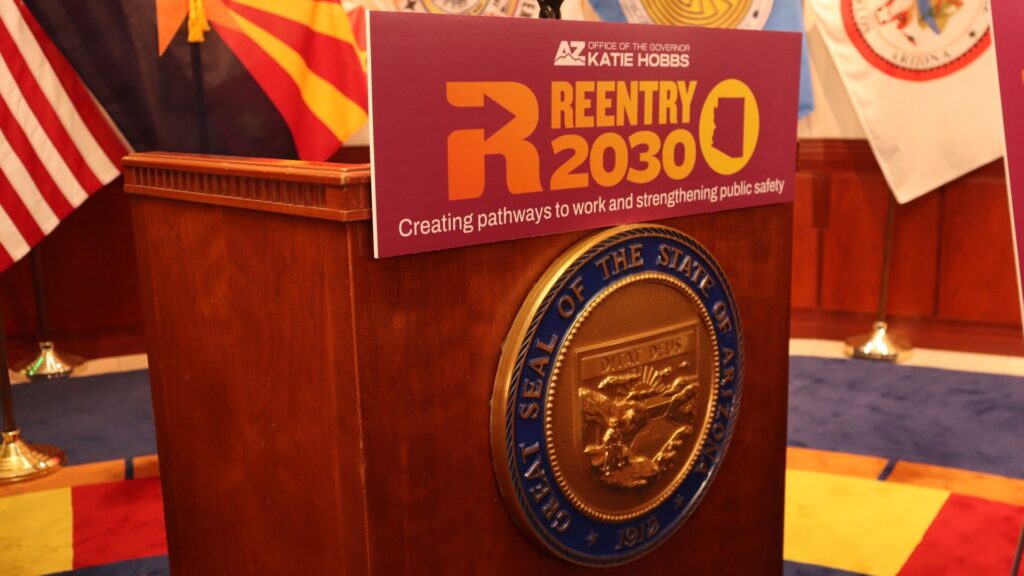
- Arizona joined Reentry 2030 in April through a gubernatorial executive order, committing to measurable goals and cross-agency collaboration.
- Nebraska’s Reentry Continuity Advisory Board—created by LB 631 to improve cross-agency collaboration, monitor the effectiveness of reentry services, and enhance outcomes for people returning home after incarceration—convened and submitted its inaugural report to the legislature.
- North Carolina added a new champion to its statewide reentry efforts by appointing First Lady Anna Stein to the state’s Joint Reentry Council, providing high-level visibility and support for reentry efforts statewide.
- Washington passed SB 5139, expanding the Statewide Reentry Council to include currently incarcerated people, victims of crime, and more representation from other state agencies, ensuring that lived experience directly informs reentry policy and system improvements.
Advancing Policy That Removes Barriers to Reentry Success
- The CSG Justice Cener hosted a virtual reentry briefing where bipartisan congressional champions and Reentry 2030 state leaders highlighted the impact of the Second Chance Act and the need for continued federal investment. Criminal justice executives, including the Alabama Bureau of Pardons and Paroles Director Cam Ward, met with congressional leaders on Capitol Hill to discuss the importance of the Second Chance Act and share success stories related to reentry to express its impact within his state and for Reentry 2030. In May, the Second Chance Reauthorization Act of 2025 was introduced in the Senate and the U.S. House of Representatives. The bipartisan act would ensure the continuation of critical reentry services for people after incarceration including housing, education, substance use disorder treatment, and job training.
- The Alabama legislature unanimously passed bipartisan workforce and occupational licensing legislation (SB138), removing unnecessary barriers and expanding pathways to employment for people with criminal records. The Free to Work legislation prohibits licensing boards from automatically disqualifying applicants with a conviction unrelated to the licensed activity, expands orders of limited relief to protect employers from negligent hiring liability, and creates a new certificate of employability to reduce legal risk, give employers greater flexibility to make their own hiring decisions, and open doors to meaningful employment.
- New York made prison phone calls free through administrative action. This significant policy change eliminates financial barriers to communication and strengthens the vital connections between incarcerated individuals and their loved ones.
Increasing Access to Employment, Housing, and Health Care After Incarceration
- States were awarded new workforce funding for reentry employment programs to support people transitioning from incarceration. North Carolina received $4 million to launch its Pathways to Reentry project to expand workforce services to incarcerated people pre- and post-release. Washington received $3 million to fund justice-impacted employment specialists to provide job placement, skills assessments, and wraparound supports.
- The Missouri DOC launched a partnership with Connections to Success to prepare soon-to-be-released Missourians for “fulfilling new jobs and new lives after prison,” emphasizing job readiness, career coaching, and wraparound supports as part of the department’s reentry strategy.
- Nebraska supported entrepreneurship through a partnership with RISE, hosting seven business academy pitch competitions to prepare justice-involved individuals with skills to launch their own businesses upon release.
- States developed new housing opportunities for people released from incarceration. New York expanded its pilot Housing Assistance Program, converting a correctional facility into transitional housing for people on parole. Once housing is approved, a family member or friend who provides housing is eligible for a 12-week stipend to offset living costs. With funding from the governor and legislature, New York also launched a new housing assistance program to support released people seeking independent living. In North Carolina, Benevolence Farm broke ground on the state’s first independent transitional housing community specifically designed for formerly incarcerated women.
- States enrolled more people in Medicaid prior to release and in reentry, ensuring continuity of health care and coverage after incarceration. New York is tracking its success, and in 2025, 77% of eligible released individuals were enrolled in Medicaid. Washington increased enrollment for eligible individuals from approximately 45% to 60% at release with a health care discharge plan.
- Washington created the first state corrections owned and operated mobile dental clinic to provide comprehensive dental services during incarceration. The clinic addresses the long-standing issues of limited access to dental care during incarceration, which helps people start getting these health needs met prior to release.
Expanding Reentry Services and Programs
- States expanded peer support across corrections and reentry programming. Arizona launched a Peer Support Program in July to deliver co-led educational, vocational, and rehabilitative programming throughout its prisons. Nebraska strengthened peer engagement through its Positive Peers program, which led town halls at state correctional facilities to share resources and programs available at community corrections centers.
- States created new reentry programming to better support incarcerated women. The Alabama Bureau of Pardons and Paroles broke ground on the CARE Center, a new residential rehabilitation facility designed to help women successfully transition back into their communities. Arizona opened the HOPE for Success Center at Perryville correctional facility, a partnership with Dress for Success Arizona to provide career training and educational opportunities.
- States strengthened family connections during incarceration to support reunification, from creating a free bus program in New York to visit with an incarcerated loved one, to hosting a “fishing with dad” event in Alabama for incarcerated fathers.
- Missouri successfully completed its Reentry Center project and now has fully operational Reentry Centers in all 19 correctional facilities and 2 transition centers. Reentry Centers help people search and apply for jobs, explore education opportunities, navigate the child support process, learn computer skills, and get help with social services such as SNAP and Medicaid. Each Reentry Center has new technology that includes virtual reality headsets providing career simulation programming.
- Through a partnership with the Department of Motor Vehicles, the New York State Department of Corrections and Community Supervision issued over 950 non-driver IDs in 2025 to incarcerated people prior to release. In 2025, 95% of individuals released who were born in New York state received or requested their birth certificate, and 79% of eligible released people received or requested their Social Security card. The provision of these documents is vital to justice-involved people returning to the workforce and for obtaining public assistance benefits, services, housing, and more.
- In North Carolina, the Recidivism Reduction Educational Program Services launched a Mobile Recidivism Reduction Center to deliver free reentry services directly to formerly incarcerated people.
Redefining and Measuring Reentry Success
- The CSG Justice Center released “Beyond Recidivism,” a national framework for redefining reentry data and success by more than recidivism rates and including outcomes related to employment, housing, health, and social reintegration. We also hosted a webinar with national experts and state corrections leaders on strategies for adopting more holistic, data-driven frameworks to measure reentry success.
- North Carolina launched the nation’s first Reentry 2030 Dashboard, a comprehensive, interactive tool that provides goal-oriented reentry data and tracks the state’s progress toward its Reentry 2030 goals.
Reentry 2030 states are showing that collective leadership, strategic coordination, and commitment to meeting the needs of all people returning home from incarceration can result in real impact.
Ready to get involved? Read why your state should join Reentry 2030, and email the team at reentry2030@csg.org for more information.