
May 2025
With the passage of recent legislation and a series of state-based recommendations, Alabama is positioning itself as a leader in reentry.
Since it’s Reentry 2030 launch in October 2023, state leaders from multiple sectors have been working together to achieve Alabama’s goals of reducing recidivism by 50 percent and increasing participation in workforce development by 50 percent. Now, with legislative achievements this past session addressing barriers to employment and reintegration and comprehensive recommendations approved by the Reentry Alabama Commission, the state is upholding its commitment to strengthen its reentry system and provide a coordinated set of supports to people returning to the community.
“We’re building a better Alabama for everyone one step at a time, and this legislation is a huge step in the right direction to achieving that,” said State House Rep. Parker D. Moore.
Increasing Access to Employment
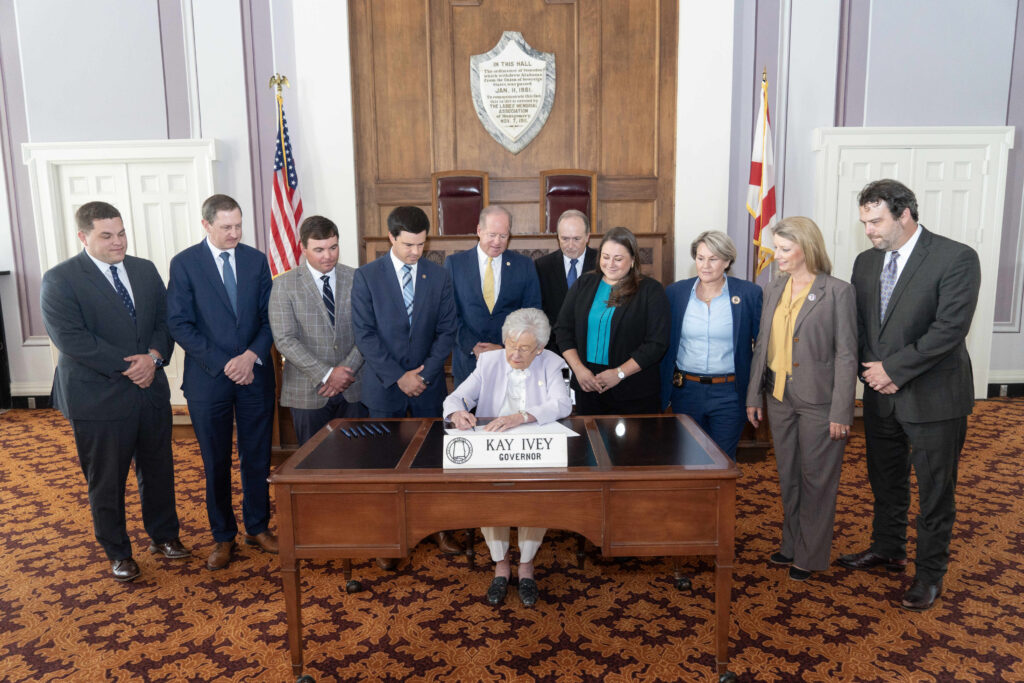
On May 14, 2025, Governor Kay Ivey signed SB138, a bipartisan bill co-sponsored by State Sen. Rodger Smitherman and Rep. Moore, removing unnecessary barriers that prevent qualified individuals with criminal records from reentering the workforce. Key provisions of the legislation include:
- Incentives to hire by addressing employer legal liability fears when hiring workers who have been granted either an Order of Limited Relief, which is a judicial order that limits the impact of barriers to work for qualifying workers with convictions, or a Certificate of Employability, a newly created credential issued by the Bureau of Pardons and Paroles to reentering workers who have participated in certain programming and have limited disciplinary records;
- Expanded access to occupational licensure by creating a framework for consistent, individualized consideration of applicants’ criminal history, intended to limit denials based solely on convictions unrelated to the licensed activity; and
- Expanded transparency by allowing workers to find out whether their criminal history is disqualifying before investing in required training and education.
“This bill allows those who have served their time, and paid their debt to society, to once again aim to achieve the American dream,” said Rep. Moore. “If our goal is to build a stronger workforce, reduce recidivism, and make Alabama the best place to live in America, we must allow job creators and job seekers to work together, which is exactly what this bill does.”
In Alabama, a license is required to work in over 150 occupations, from barbering and landscaping to nursing and architecture. With the enactment of SB138, Alabama joins the majority of states that have enacted similar “fair chance” licensing policies aimed at expanding opportunity while protecting public safety.
“This bill empowers Alabama’s businesses to make decisions that are in the best interest of their operations and their communities, while also ensuring that Alabamians with a criminal record have the opportunity to rebuild their lives,” said Sen. Smitherman. “It opens the doors to good-paying jobs and careers where they can earn a living, practice a craft, and reach new heights. We were proud to deliver a bill that targeted injustice by breaking down burdensome barriers faced all too often by thousands of Alabamians.”

Creating a Statewide Infrastructure for Reentry Improvement
On May 21, the Reentry Alabama Commission released a final report outlining its strategic goals for improving reentry outcomes of Alabamians who were previously incarcerated. This report is based on The Council of State Governments (CSG) Justice Center’s year-long partnership with state leaders, treatment and workforce development providers, and other stakeholders to assess the state’s reentry system and identify strengths, challenges, and opportunities for improvement. Based on the assessment results, the commission, with support from CSG Justice Center staff, identified and approved a comprehensive set of policy and practice recommendations that will be translated into an action plan for implementation.
The recommendations in the report focus on:
- Ensuring people are aware of the available services, benefits, and eligibility/enrollment processes before release;
- Increasing employer engagement, expanding workforce programming and job support services, and strengthening coordination across workforce, corrections, and other partner agencies;
- Expanding behavioral health treatment (including additional opportunities for peer support and access to medication-assisted treatment) and increasing the availability of safe and stable housing; and
- Strengthening data collection on reentry outcome measures, including and beyond recidivism, and ensuring that data is used to enhance decision-making.
“I am proud of Alabama’s efforts to achieve our goals for Reentry 2030,” said Cam Ward, Director of the Alabama Bureau of Pardons and Paroles. “Whether it’s through our work with the legislature on passing occupational licensing reform or our efforts convening multiple cabinet agencies and local stakeholders to develop evidence-based solutions to reentry’s most complex problems, we are excited to be leading the way in making Reentry 2030 a success.”
Next Steps For Alabama
Alabama’s comprehensive and coordinated statewide approach to Reentry 2030 has laid the groundwork for the state’s continued success. On May 6, 2025, Governor Ivey signed SJR80 into law, establishing the Alabama Statewide Reentry Task Force to continue the work of the Reentry Alabama Commission and focus on implementing its recommendations to reach the state’s Reentry 2030 goals. The task force includes state agencies from the original commission, but it also expands membership to include additional state legislators, representatives from local government, the chief justice of the Alabama Supreme Court, community-based organizations, and a person with lived experience in the criminal justice system.
Each state agency represented in the commission and task force has committed to improving coordination and taking ownership of the strategies jointly identified in the commission report. To keep momentum moving forward, the CSG Justice Center is continuing its partnership and will work with the task force to help sequence the recommendations and develop actionable plans for implementation. CSG Justice Center staff will also be working closely with the Alabama Bureau of Pardons and Paroles to strengthen the use of evidence-based practices, expand services available to people on supervision, and enhance partnerships across agencies. Local providers will also work with CSG Justice Center staff to address gaps and remove barriers to successful reentry.
For more information on Alabama’s Reentry 2030 initiative, please contact Megan Pfeiffer at mpfeiffer@csg.org.